
Kafka Data Governance: Definition & Primitives
Kafka data governance is the layer of policies and controls that determines, for every topic and message in a Kafka estate, who owns it, who can access it, what schema and quality rules apply, what data is sensitive, and how every action is audited. Kafka brokers do not provide governance on their own; it is built on top with a combination of Schema Registry, ACLs or RBAC, IAM, key management, and audit pipelines.
The Six Primitives of Kafka Data Governance
Kafka governance breaks into six independent primitives. With one team you can ignore most of them. Past a handful of teams sharing the same brokers, all six matter.
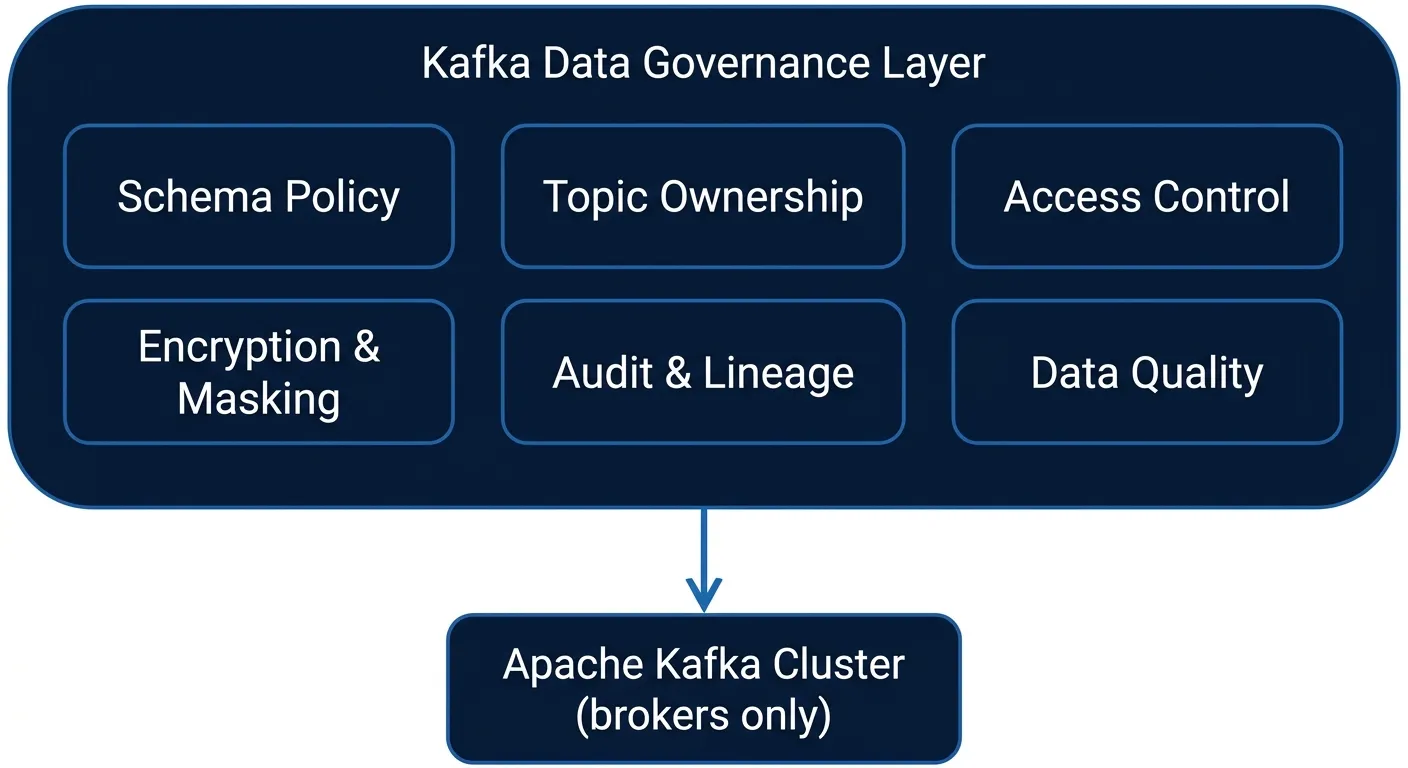
| Primitive | What it answers |
|---|---|
| Schema policy | What schema is allowed on which topic; what evolution rules apply (backward, forward, full); what happens when a producer breaks the contract |
| Topic ownership | For every topic, which application and which team is accountable; how orphan topics are detected |
| Access control | Who, human or service account, can produce, consume, create, or delete; expressed as roles and groups rather than raw principals |
| Encryption and masking | Which fields are sensitive (PII, PHI, secrets); which are encrypted at the field level; which are masked in lower environments; which keys protect them |
| Audit and lineage | Who did what, when, from where; queryable and exportable rather than raw broker log lines |
| Data quality | What validation rules a message must pass to be accepted; what happens to records that fail (reject, route to DLQ, log) |
Why Kafka Brokers Don't Provide Governance
Apache Kafka is a broker. It serves bytes. The broker has no concept of "team", "topic owner", "sensitive field", "schema contract", or "audit retention". Each governance primitive has to come from somewhere outside the broker:
- Schemas live in a Schema Registry (Confluent, Apicurio, AWS Glue). The registry stores schemas; on its own it does not block bad-shape produces or enforce ownership of subjects. See Schema Registry and Schema Management.
- Ownership lives in a separate system. Without an application or topic catalog, ownership is a wiki page or a spreadsheet that drifts from reality.
- Access lives in
kafka-acls.shfor the broker layer, sometimes layered with RBAC. See Kafka ACLs and Access Control for Streaming. - Encryption is split between TLS on the wire, KMS-backed keys for field-level encryption, and disk encryption for at-rest data — three layers that need to be configured independently.
- Audit is broker logs (Log4j authorizer output, request logs) shipped to a SIEM. The brokers do not produce a queryable audit history on their own.
- Data quality is either enforced at produce time by the application, or at the gateway/proxy layer, or not at all.
Multiply that by 20 teams, 500 topics, three clusters, and a compliance reviewer asking "who has access to topics containing PII?", and the missing pieces stop looking like background admin.
Maturity Levels
Most teams pass through four stages, usually in this order:
- Ad hoc — ACLs added during incidents, no Schema Registry, no central audit. One platform engineer knows where everything is.
- Discoverable — Schema Registry deployed, topic naming conventions written down (if not enforced), brokers shipping audit to a SIEM.
- Owned — topics registered against applications and teams, access requests go through a workflow, schema breaking changes blocked at produce time.
- Programmable — governance expressed as code (Terraform, GitOps), policies enforced declaratively, audit and quality rules versioned alongside application code.
Stages 3 and 4 are where governance stops being its own workstream and just becomes how the platform behaves.
Governance vs Security
The two overlap but are not the same. Security answers "can the wrong person reach the data?" — encryption, authentication, authorization. Governance answers "can the right person reach the right data with the right shape?" — security plus schema, ownership, quality, lineage. See Kafka Security: The Four Pillars for the security-only frame.
Implementing Kafka Data Governance
In practice, these six primitives live in a platform layered on top of Kafka, not in the brokers. For how Conduktor implements them in one control plane, see the Kafka governance platform page.
Related Pages
- Kafka ACLs, how broker-level access control works and where it stops scaling
- Schema Registry and Schema Management, the contract layer that governance relies on
- Access Control for Streaming, patterns for ACLs and RBAC across consumer groups and topics
- Audit Logging for Streaming Platforms, shipping broker events to a SIEM
- Automated Data Quality Testing, validation rules for messages in flight
- Kafka Security: The Four Pillars, the security subset of governance
Sources
- Apache Kafka Documentation, Security and Authorization
- Confluent Schema Registry Documentation
- NIST RBAC Standard (INCITS 359)
- DAMA-DMBOK: Data Management Body of Knowledge, the broader data governance frame Kafka governance fits into