
Why Your Kafka Architecture Should Not Depend on Any Single Vendor
IBM's acquisition of Confluent brings investment, stability, and enterprise support to the streaming industry. These are real benefits.
Streaming now sits at the center of business operations, analytics, and AI systems. When infrastructure at this level consolidates, architecture decisions matter more. Your streaming architecture needs to be designed for long-term flexibility as the ecosystem evolves.
Vendor Neutrality Is Architectural, Not Contractual
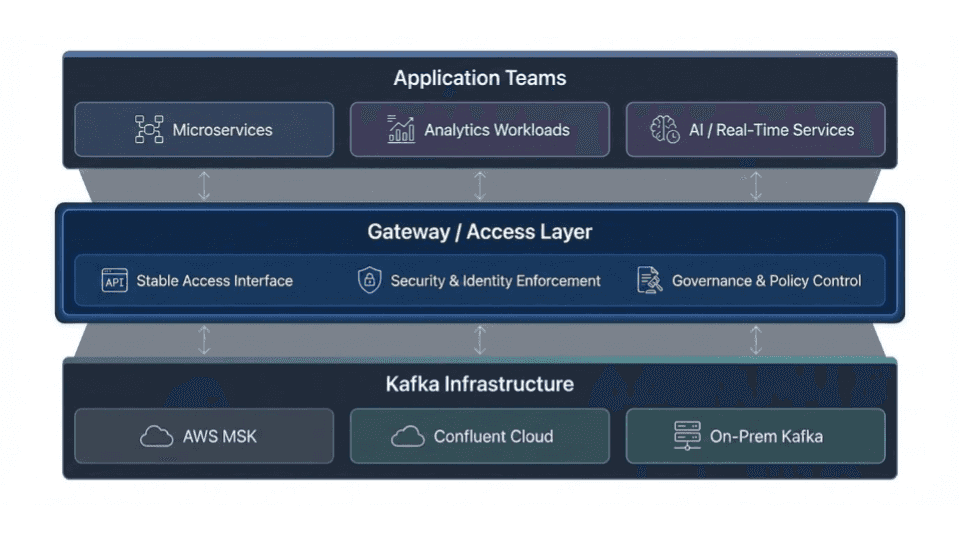
Vendor neutrality is often misunderstood as supporting multiple providers. In practice, it means your streaming architecture is not tightly bound to any one provider's infrastructure, APIs, configuration model, or operational patterns. It can operate consistently across multiple environments without rewriting applications or rebuilding governance.
This means:
- Applications connect to a stable access layer, not vendor-specific endpoints
- Security, identity, and governance are applied independently of the underlying Kafka provider
- Data contracts and schemas are managed outside any single vendor's tooling
- Infrastructure can change without becoming an application-level project
This distinction becomes important as the ecosystem consolidates and platforms mature.
Operational Costs Grow Faster Than Infrastructure Costs
Total cost of ownership in streaming is not just vendor pricing. It is the cumulative operational cost of onboarding applications, managing access, enforcing security, standardizing environments, and keeping clusters stable as usage grows.
As Kafka adoption expands, more teams publish data, more services consume it, and more real-time workloads depend on low-latency streams. The result is not just higher infrastructure spend, but growing coordination overhead across teams and environments.
The IBM–Confluent deal is prompting organizations to ask:
- How do we scale Kafka usage without scaling headcount?
- How do we apply the same governance rules across cloud and on-prem environments?
- How do we avoid duplicating operational work as architectures evolve?
Swiss Post illustrates this challenge. During a nine-month migration of 25 on-prem Kafka clusters and 170 applications to Confluent Cloud, they needed consistent security, governance, and self-service access for more than 2,000 developers. The migration itself was only part of the effort. Preserving operational consistency across environments was the harder problem.
Vendor-neutral architectures reduce TCO by giving organizations control over where complexity lives. Teams can centralize governance and connectivity while letting infrastructure evolve underneath.
Hybrid Reality Demands Architectural Flexibility
Most enterprises already operate in a hybrid reality. Cloud migrations are gradual. Regulatory requirements differ by region. Mergers and acquisitions introduce inherited platforms.
Without a vendor-neutral design, architectural flexibility erodes over time. Teams end up maintaining multiple operational playbooks, duplicating governance logic, and rebuilding integrations for each environment. Architecture decisions become shaped by platform constraints rather than business needs.
Vendor-neutral architectures preserve optionality. They allow organizations to evolve infrastructure independently of applications, applying the same access patterns, security rules, and governance models regardless of where Kafka runs.
How to Migrate Without Disrupting Applications
Infrastructure change is inevitable. Migrations do not have to be disruptive.
When applications connect directly to vendor endpoints, SDKs, and configuration models, even small infrastructure changes require widespread redeployments. This coupling turns migrations into multi-quarter initiatives that teams delay unless absolutely necessary.
Vendor-neutral architectures decouple applications from infrastructure choices. Applications connect to a central access layer, while routing, failover, and backend transitions happen behind the scenes.
One large enterprise airline undergoing a multi-year middleware modernization described this clearly. As they migrated from legacy messaging systems to Kafka, avoiding repeated application changes during each phase was critical to maintaining delivery timelines. Abstracting infrastructure changes behind a stable access layer allowed migrations to proceed incrementally instead of as high-risk cutovers.
Resilience Comes From Control, Not Dependence
Resilience is not only about uptime. It is about maintaining control as vendors change roadmaps, pricing models, or strategic priorities.
When security, identity, and governance are tightly coupled to a single provider, organizations inherit that provider's constraints. Changes outside the organization's control ripple through operations.
Vendor-neutral architectures introduce a buffer. Governance, identity integration, and data contracts live above the infrastructure layer, not inside it.
This allows organizations to:
- Apply security and governance consistently across providers
- Integrate with enterprise identity systems (LDAP, SSO) independently
- Manage schemas and data contracts outside vendor-specific registries
- Maintain operational continuity during regional outages or platform changes
The Streaming Ecosystem Is Consolidating. Your Architecture Should Stay Flexible.
IBM's $11B acquisition of Confluent confirms that streaming is foundational infrastructure, not optional.
This marks a new phase. As the ecosystem consolidates, organizations must decide whether their streaming architecture is designed for long-term flexibility or long-term constraint.
The teams that succeed will:
- Manage operational cost as adoption scales
- Preserve flexibility across hybrid environments
- Migrate infrastructure without disrupting applications
- Maintain resilience as vendors and platforms evolve
The most practical first step: decouple applications from Kafka infrastructure by introducing a neutral, stable access and governance layer between clients and clusters. Conduktor enables organizations to take this step, restoring control over streaming architecture while allowing infrastructure, vendors, and environments to change over time.
Learn more about how Conduktor supports vendor-neutral streaming architectures.