
Automated Data Quality Testing: A Practical Guide for Modern Data Pipelines
Data quality issues cost organizations millions annually through incorrect analytics, failed ML models, and broken downstream systems. As data pipelines grow more complex, especially with real-time streaming architectures, manual testing becomes impractical. Automated data quality testing is essential for maintaining trust in your data infrastructure.
Why Automate Data Quality Testing?
Traditional manual data validation doesn't scale. When dealing with hundreds of data sources, schema evolution, and continuous data flows, you need systematic, automated approaches to catch issues before they propagate downstream.
Automated testing provides:
- Early detection: Catch schema changes, null values, and data anomalies immediately
- Continuous validation: Test data quality in real-time as it flows through pipelines
- Regression prevention: Ensure transformations don't break existing data contracts
- Documentation: Tests serve as executable specifications of data expectations
Core Testing Dimensions
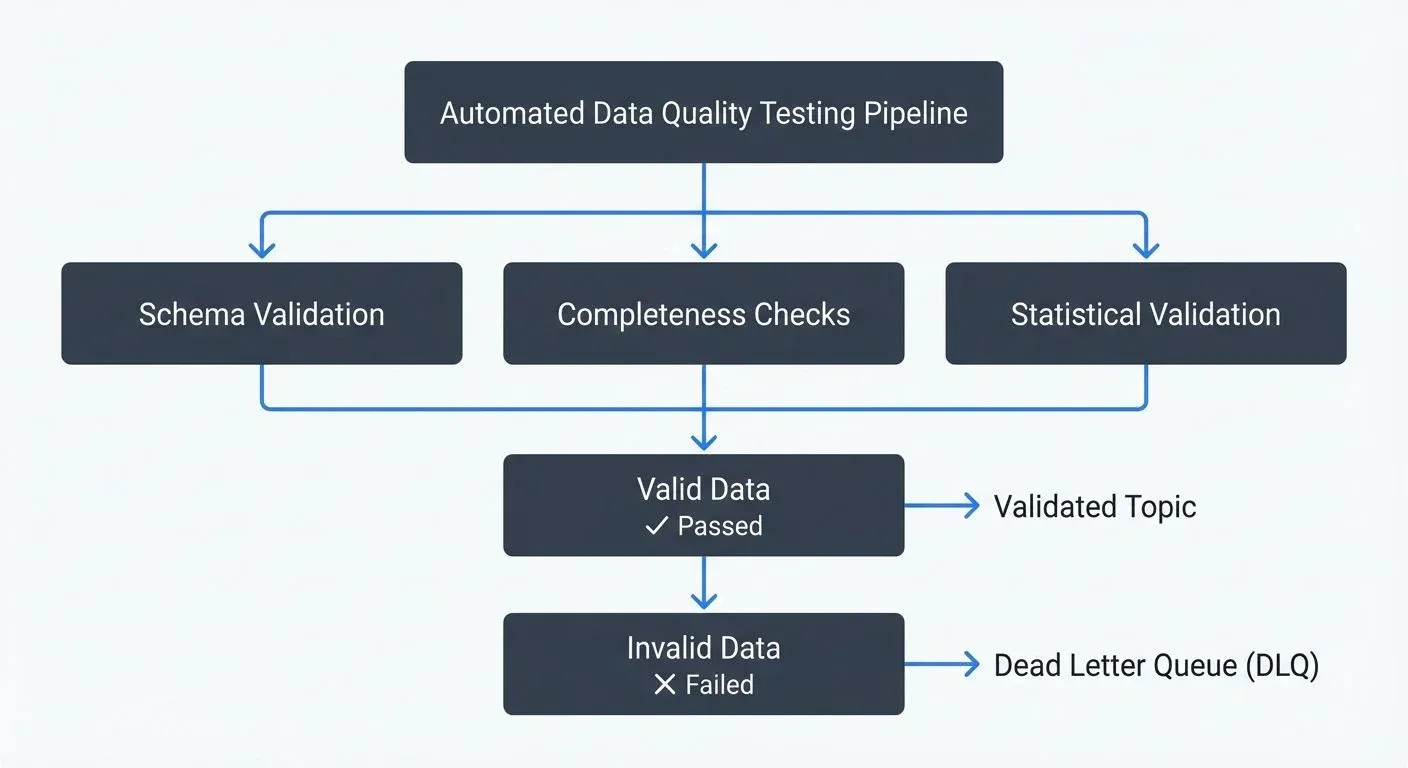
Effective data quality testing covers multiple dimensions. For broader context on quality dimensions and how they relate to organizational data strategy, see Data Quality Dimensions: Accuracy, Completeness, and Consistency.
1. Schema Validation
Ensure data structures match expected schemas, particularly critical in streaming environments where schema evolution can break consumers.
from pydantic import BaseModel, Field, field_validator
from typing import Optional
from datetime import datetime

class UserEvent(BaseModel):
    user_id: str = Field(..., min_length=1)
    event_type: str
    timestamp: datetime
    properties: dict
    revenue: Optional[float] = None

    @field_validator('revenue')
    @classmethod
    def validate_revenue(cls, v):
        if v is not None and v < 0:
            raise ValueError('Revenue cannot be negative')
        return v

    @field_validator('event_type')
    @classmethod
    def validate_event_type(cls, v):
        allowed_types = {'page_view', 'click', 'purchase', 'signup'}
        if v not in allowed_types:
            raise ValueError(f'Event type must be one of {allowed_types}')
        return v

# Validation in streaming pipeline
def validate_event(event_json: dict) -> bool:
    try:
        UserEvent(**event_json)
        return True
    except Exception as e:
        log_validation_error(e, event_json)
        return False
2. Data Completeness
Check for missing values, null rates, and required field presence.
import pandas as pd
from typing import List, Dict

class CompletenessValidator:
    def __init__(self, required_fields: List[str], max_null_rate: float = 0.05):
        self.required_fields = required_fields
        self.max_null_rate = max_null_rate

    def validate_batch(self, df: pd.DataFrame) -> Dict[str, any]:
        results = {
            'passed': True,
            'issues': []
        }

        # Check required fields exist
        missing_fields = set(self.required_fields) - set(df.columns)
        if missing_fields:
            results['passed'] = False
            results['issues'].append(f'Missing required fields: {missing_fields}')

        # Check null rates
        for field in self.required_fields:
            if field in df.columns:
                null_rate = df[field].isna().sum() / len(df)
                if null_rate > self.max_null_rate:
                    results['passed'] = False
                    results['issues'].append(
                        f'{field} null rate {null_rate:.2%} exceeds threshold {self.max_null_rate:.2%}'
                    )

        return results

# Usage
validator = CompletenessValidator(required_fields=['user_id', 'timestamp', 'event_type'])
validation_result = validator.validate_batch(events_df)
assert validation_result['passed'], f"Validation failed: {validation_result['issues']}"
3. Statistical Validation
Detect anomalies using statistical boundaries and historical patterns.
import numpy as np
from scipy import stats

class StatisticalValidator:
    def __init__(self, historical_mean: float, historical_std: float, z_threshold: float = 3.0):
        self.mean = historical_mean
        self.std = historical_std
        self.z_threshold = z_threshold

    def validate_metric(self, current_value: float) -> Dict[str, any]:
        z_score = abs((current_value - self.mean) / self.std)
        is_anomaly = z_score > self.z_threshold

        return {
            'value': current_value,
            'z_score': z_score,
            'is_anomaly': is_anomaly,
            'expected_range': (
                self.mean - self.z_threshold * self.std,
                self.mean + self.z_threshold * self.std
            )
        }

# Example: Validate daily record count
daily_count_validator = StatisticalValidator(
    historical_mean=1_000_000,
    historical_std=50_000,
    z_threshold=3.0
)

current_count = 1_200_000
result = daily_count_validator.validate_metric(current_count)

if result['is_anomaly']:
    alert(f"Anomalous record count: {current_count} (z-score: {result['z_score']:.2f})")
Streaming Data Quality with Kafka
For streaming pipelines, data quality testing must happen in real-time. When using Apache Kafka, streaming management tools provide valuable capabilities for monitoring and validating data quality in real-time contexts.
For foundational understanding of Kafka architecture and streaming patterns, see Apache Kafka.
Real-Time Validation Pattern
from kafka import KafkaConsumer, KafkaProducer
import json

class StreamingQualityTester:
    def __init__(self, bootstrap_servers: str, consumer_group: str = 'quality-tester'):
        self.consumer = KafkaConsumer(
            'raw-events',
            bootstrap_servers=bootstrap_servers,
            group_id=consumer_group,
            auto_offset_reset='earliest',
            enable_auto_commit=False,  # Manual commit for exactly-once
            value_deserializer=lambda m: json.loads(m.decode('utf-8'))
        )

        self.valid_producer = KafkaProducer(
            bootstrap_servers=bootstrap_servers,
            acks='all',  # Wait for all replicas
            value_serializer=lambda m: json.dumps(m).encode('utf-8')
        )

        self.dlq_producer = KafkaProducer(
            bootstrap_servers=bootstrap_servers,
            acks='all',
            value_serializer=lambda m: json.dumps(m).encode('utf-8')
        )

        self.metrics = {
            'processed': 0,
            'valid': 0,
            'invalid': 0
        }

    def run(self):
        try:
            for message in self.consumer:
                self.metrics['processed'] += 1
                event = message.value

                # Run validation suite
                validation_results = self.validate_event(event)

                if validation_results['passed']:
                    self.valid_producer.send('validated-events', event)
                    self.metrics['valid'] += 1
                else:
                    # Send to dead letter queue with error details
                    error_event = {
                        **event,
                        '_validation_errors': validation_results['errors'],
                        '_original_topic': 'raw-events',
                        '_timestamp': message.timestamp
                    }
                    self.dlq_producer.send('validation-dlq', error_event)
                    self.metrics['invalid'] += 1

                # Commit offset after successful processing
                self.consumer.commit()

                # Report metrics periodically
                if self.metrics['processed'] % 1000 == 0:
                    self.report_metrics()
        finally:
            # Ensure clean shutdown
            self.consumer.close()
            self.valid_producer.close()
            self.dlq_producer.close()

    def validate_event(self, event: dict) -> Dict[str, any]:
        errors = []

        # Schema validation
        try:
            UserEvent(**event)
        except Exception as e:
            errors.append(f'Schema validation failed: {str(e)}')

        # Business rule validation
        if event.get('event_type') == 'purchase' and not event.get('revenue'):
            errors.append('Purchase events must include revenue')

        return {
            'passed': len(errors) == 0,
            'errors': errors
        }

    def report_metrics(self):
        success_rate = self.metrics['valid'] / self.metrics['processed'] * 100
        print(f"Processed: {self.metrics['processed']}, "
              f"Success Rate: {success_rate:.2f}%")
Quality Monitoring for Kafka Streams
Streaming management platforms provide visual monitoring and testing capabilities for Kafka streams:
- Monitor schema registry: Track schema evolution and catch breaking changes. For details on schema management patterns, see Schema Registry and Schema Management.
- Validate message format: Configure validation rules for incoming data. For implementing validation with Conduktor, see Enforcing Data Quality.
- Dead letter queue management: Easily inspect and replay failed messages. For error handling patterns, see Dead Letter Queues for Error Handling.
Set up quality gates to automatically route messages through validation topics, making it easy to visualize quality metrics and troubleshoot issues. For observing data quality metrics, see Observing Data Quality with Conduktor.
Continuous Validation with Data Quality Policies
Conduktor Data Quality Policies complement automated testing by providing infrastructure-level continuous validation. Data Quality Policies create Rules defining expected message formats and content that attach to specific topics, creating a centralized quality enforcement layer. In observe-only mode, Policies record violations without impacting message flow; when integrated with Conduktor Gateway (a Kafka proxy), they validate records before production, blocking or marking non-compliant messages.
This layered approach combines development-time testing with production-time enforcement, catching edge cases that testing environments might miss. For implementation patterns, see Data Quality Policies.
Implementing a Testing Framework
Build a comprehensive testing framework that runs continuously:
class DataQualityTestSuite:
    def __init__(self, name: str):
        self.name = name
        self.tests = []
        self.results = []

    def add_test(self, test_name: str, test_func: callable):
        self.tests.append((test_name, test_func))

    def run(self, data: any) -> bool:
        self.results = []
        all_passed = True

        for test_name, test_func in self.tests:
            try:
                result = test_func(data)
                self.results.append({
                    'test': test_name,
                    'passed': result['passed'],
                    'details': result.get('details', '')
                })
                if not result['passed']:
                    all_passed = False
            except Exception as e:
                self.results.append({
                    'test': test_name,
                    'passed': False,
                    'details': f'Test failed with exception: {str(e)}'
                })
                all_passed = False

        return all_passed

    def generate_report(self) -> str:
        report = [f"\nTest Suite: {self.name}"]
        report.append("=" * 50)

        for result in self.results:
            status = "PASS" if result['passed'] else "FAIL"
            report.append(f"[{status}] {result['test']}")
            if result['details']:
                report.append(f"  Details: {result['details']}")

        passed = sum(1 for r in self.results if r['passed'])
        total = len(self.results)
        report.append(f"\nResults: {passed}/{total} tests passed")

        return "\n".join(report)
Best Practices
- Test early and often: Validate data at ingestion, transformation, and output stages
- Separate validation logic: Keep quality tests decoupled from business logic
- Monitor quality metrics: Track validation success rates, common failure patterns
- Design for failure: Use dead letter queues and graceful degradation
- Version your tests: Treat quality tests as code with proper version control
- Balance strictness: Too strict validation creates false positives; too lenient misses real issues
Summary
Automated data quality testing shifts data reliability from a reactive problem to a proactive one. By validating across schema, completeness, and statistical dimensions — particularly in streaming architectures — you build data systems that teams can trust.
For production-grade implementation using established frameworks, see Great Expectations: Data Testing Framework. For formal agreements between data producers and consumers, see Data Contracts for Reliable Pipelines.
Automated testing reduces debugging time, improves confidence in data-driven decisions, and speeds up incident resolution.
Related Concepts
- Building a Data Quality Framework - Comprehensive approach to quality management
- Schema Registry and Schema Management - Schema validation infrastructure
- Data Contracts for Reliable Pipelines - Contract-based validation strategies
Sources and References
- Great Expectations Documentation - Leading open-source framework for data validation and quality testing
- Apache Kafka Schema Registry - Schema validation and evolution management for streaming data
- Pydantic Data Validation - Python library for data validation using type annotations
- dbt Data Testing - Testing framework for analytics engineering and data transformations
- AWS Glue Data Quality - Automated data quality monitoring for data pipelines