
Kafka Proxy: Beyond the Routing Layer
A Kafka proxy should do more than route traffic. The right one gives your platform team three things: a central control point to connect clients to clusters, the isolation and tooling to govern Kafka across teams, and wire-level enforcement to protect your data without changing applications. Most proxies only deliver the first.
- A Kafka proxy sits between your clients and your clusters. Every message passes through it.
- Think of a proxy as doing three jobs: Connect (abstract clients from clusters), Govern (let multiple teams share safely), and Protect (enforce security at the wire).
- Every proxy on the market handles Connect: stable endpoints, backend remapping, DR failover. That part is solved.
- Govern is where it gets interesting. Virtual clusters, layered isolation, best practice enforcement, operational tooling that doesn't require YAML and a redeploy for every policy change.
- Protect is where most proxies have nothing at all. Wire-level encryption, masking, data quality, schema registry governance, all covering every client without code changes.
- Routing-only proxies stop at Connect. API gateways bolt on some Govern. Open-source proxies give you building blocks but your team does the rest. Purpose-built proxies are the only option that ships all three.
What is a Kafka proxy?
A Kafka proxy is a layer between your Kafka clients and your Kafka clusters. It intercepts the native Kafka protocol so clients connect to the proxy instead of directly to brokers, but from their perspective nothing changes: the same protocol, the same client libraries, no code modifications.
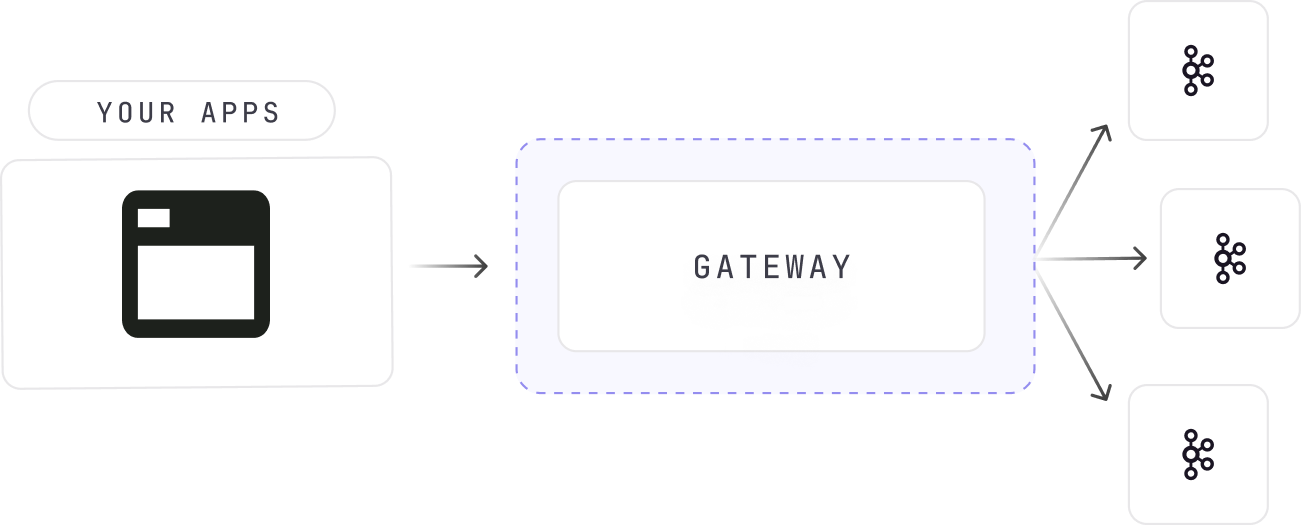
Routing traffic is the floor. The interesting part is what else the proxy can do once it's sitting in the path of every message. We think about this in three stages:
01. Connect
Abstract clients from clusters. Route traffic, switch backends, fail over, all without changing applications.
02. Govern
Let multiple teams share Kafka safely. Isolate, enforce guardrails, and give platform teams operational tooling.
03. Protect
Enforce security and data quality at the wire. Every client covered, no bypass possible, no code changes needed.
All proxies provide the Connect functionality. Where proxies actually differ is Govern and Protect, and whether any of it works once you have more than one team on a cluster. The rest of this page walks through each stage in detail.
Stage 01 — Connect
Can I abstract my clients from my clusters?
Every Kafka proxy you'll evaluate can route traffic through a stable endpoint. The part worth paying attention to is whether your platform team can remap, migrate, and fail over backend clusters without touching a single application.
Client abstraction
At a minimum, a useful proxy gives you:
- A stable endpoint. Clients connect to the proxy, not directly to broker addresses. When brokers change, the proxy handles it.
- Backend remapping. Point clients at a different cluster by changing the proxy configuration, not by redeploying every application.
- DR failover. Switch traffic to a standby cluster centrally. The question is whether you can do this via an API call or whether it requires a redeploy of the proxy itself.
If your proxy can't do these three things without client-side changes, your platform team is going to spend migration weekends coordinating application teams instead of just flipping a switch.
DR readiness vs. DR switching
All proxies can switch clusters. The hard part is knowing your applications will actually survive the switch.
A proxy that takes DR seriously provides:
- Chaos testing. Simulate broker failures, latency spikes, and leader elections against your live traffic to validate that applications handle failover correctly.
- API-driven switching. Change the backend cluster without redeploying the proxy. In an emergency, the difference between an API call and a change management cycle matters.
Without readiness validation, you're finding out whether DR works during an actual outage. That's not a DR strategy, it's a gamble.
Go deeper: Client abstraction → · DR and Failover → · Chaos testing for Kafka →
DR is more than cluster switching. Our ebook Kafka Disaster Recovery: Beyond Replication covers the full strategy, from replication topology to readiness validation and runbook design.
Stage 02 — Govern
Can multiple teams share Kafka safely?
Most proxies stop being useful right about here. They were built assuming one team runs one cluster, but once you have five teams on shared Kafka infrastructure, that assumption falls apart. Teams step on each other, the platform team becomes a bottleneck for every change, and eventually someone says "just give us our own cluster" because isolation doesn't exist.
Multi-tenancy and layered isolation
Real multi-tenancy means each team operates as if they have their own Kafka cluster, while actually sharing physical infrastructure. This requires multiple layers working together:
- Virtual clusters that give each team their own logical environment with separate topic namespaces.
- ACLs that control who can access what within each virtual cluster.
- Traffic control policies that prevent one team's workload from impacting another's: quotas, rate limits, and resource boundaries.
The distinction matters. Some proxies offer virtual clusters with basic ACLs, but that only provides access control, not isolation. When your tenth team onboards and one of them starts producing 10x the expected volume, access control alone won't protect the other nine: layered policies do.
If your proxy separates teams by naming conventions, it's not multi-tenancy, it's an honor system.
Best practice enforcement
As more teams use Kafka, inconsistency becomes the default. Without enforcement at the proxy:
- Teams create topics with wildly different configurations (replication factor 1 in production, anyone?)
- Naming conventions exist in a wiki but aren't enforced anywhere
- Consumer groups proliferate without ownership
- The platform team reviews every change manually because there's no automated guardrail
A proxy with composable interceptors lets the platform team define the rules once and enforce them on every request automatically. Topic naming conventions, replication minimums, partition limits, rate limits, all applied per virtual cluster without requiring each team to know or care about the policies.
Operational tooling
Governance also means the proxy itself needs to be operable at scale. If every configuration change requires editing YAML and redeploying the proxy, your platform team is going to spend more time managing the proxy than managing Kafka.
Production-ready operational tooling means:
- Terraform provider so proxy configuration fits into the same IaC workflows as the rest of your infrastructure.
- CLI and REST API for automation and scripting.
- Runtime configuration so policy changes take effect without restarts or redeployment.
If onboarding a new team requires a pull request, a YAML edit, a CI pipeline, and a proxy restart, you've traded one bottleneck for another.
Go deeper: Multi-tenancy → · Best practice enforcement →
Stage 03 — Protect
Is my data protected at the wire?
This isn't where most organizations start, but where many end up. The proxy already sits in the path of every message, so it's the obvious place to enforce security and data quality. No client changes, no library to install, no team that can accidentally (or deliberately) bypass the rules.
If you pick a proxy that has these capabilities built in, you turn them on when you need them. If your proxy doesn't have them, you re-platform.
Wire-level security
The critical distinction is where enforcement happens. With client-side enforcement (like Confluent's CSFLE), each application must include a specific library. Any application that doesn't include it sends data unencrypted. With wire-level enforcement, the proxy handles it:
- Field-level encryption. Encrypt specific fields within a message (just the PII, not the whole payload) with KMS integration. Every client is covered regardless of language or framework.
- Tokenization. Replace sensitive values with non-reversible tokens at the proxy. The original data never reaches downstream consumers, but the token preserves referential integrity so joins and aggregations still work.
- Cryptographic signing. Attach signatures to messages at the proxy to prove authenticity and detect tampering. Consumers can verify that a message hasn't been modified since it passed through the proxy.
Ask any proxy vendor: "What happens when a new application gets deployed without the encryption library?" If the answer is "that data goes through unencrypted," your security has an exception for every team that doesn't follow the process.
Data quality
Bad data in Kafka is expensive to fix after the fact. A proxy can catch it at the source:
- Schema enforcement. Validate that messages conform to their registered schema before they reach the broker.
- Business rule validation. Enforce rules beyond schema compliance: field value ranges, required fields, format constraints.
- Blocking and routing. Reject bad data at the wire or route it to a dead letter topic for investigation.
Most schema registries validate schemas but not the data itself. A proxy that enforces data quality at the wire closes that gap.
Schema registry governance
Most organizations' schema registries are either wide open or locked behind basic auth. One accidental breaking change to a schema can cascade through downstream consumers and turn into a production incident.
A dedicated schema registry proxy adds:
- Modern authentication. JWT/OIDC token validation (Keycloak, Auth0, Okta, Azure AD) so your registry uses the same identity provider as the rest of your infrastructure.
- Per-subject access control. Teams can only register or modify schemas for the subjects they own. Read and write permissions with wildcard and prefix matching.
- Audit logging. Every schema operation is traced (OpenTelemetry), metered (Prometheus), and logged. When something breaks, you can trace it back to the schema change that caused it.
External data sharing
Sharing Kafka data with external partners goes beyond just exposing an endpoint. Without isolation at the proxy layer, an external consumer can impact your internal infrastructure through excessive polling, unbounded consumption, or unexpected traffic patterns.
A proxy designed for external data sharing provides:
- Dedicated partner zones with their own isolation and traffic control policies.
- Resource boundaries that prevent a partner's workload from affecting internal teams.
- Access controls scoped to exactly the topics and operations the partner needs, and nothing more.
Go deeper: Data security → · Schema Registry Proxy → · External data sharing →
Wire-level security covers more than encryption. Our ebook Achieving Data Security for Kafka breaks down the full toolkit: encryption, masking, tokenization, and how to build a security layer that doesn't depend on every team getting it right.
A scan of the landscape, scored through the Connect / Govern / Protect lens. For a detailed feature-by-feature comparison with specific products, see our Kafka proxies comparison page.
Routing-Only Proxies
Built for Connect: cluster migration, DR failover, and client abstraction. Strong at routing, but no multi-tenancy, no policy enforcement, and no data security at the proxy layer. You'll outgrow it the moment you need Govern or Protect.
Examples: Confluent Gateway.
API Gateway Extensions
API management platforms that added Kafka support. Good Connect story if you already run one for REST APIs. Limited Govern (topic aliasing instead of virtual clusters, basic policies instead of composable interceptors). Protect capabilities are maturing but typically shallower than a purpose-built proxy.
Examples: Kong Event Gateway, Gravitee Kafka Gateway.
Open-Source Proxies
Deliver Connect for free, with building blocks for Govern. But your team owns all the engineering: custom filters, YAML configuration, every upgrade. No Protect capabilities out of the box. Most organizations exceed the cost of a commercial product within the first year.
Examples: Kroxylicious, Aklivity Zilla.
Purpose-Built Kafka Proxies
Designed for all three stages. Connect, Govern, and Protect from a single product, with operational tooling that doesn't require your platform team to build and maintain it themselves. The only category that covers the full spectrum of proxy use cases out of the box.
Examples: Conduktor Gateway.
Every capability in Conduktor Gateway maps back to one of the three stages. Works with any Kafka provider: Confluent, MSK, Redpanda, Aiven, and open-source Apache Kafka.

Read more customer stories
What is a Kafka proxy?
A Kafka proxy is a layer between your Kafka clients and your Kafka clusters. It intercepts the native Kafka protocol so every message passes through it, giving platform teams a single control point for routing, multi-tenancy, security, governance, and operational management without changing applications.
What is the difference between a Kafka proxy and an API gateway?
An API gateway manages HTTP/REST traffic. Some API gateways have added Kafka support, but their Kafka proxy capabilities (layered multi-tenancy, composable policy enforcement, schema registry governance) are typically shallower than a purpose-built Kafka proxy. They're best suited when Kafka is one of many integration points, not the primary infrastructure.
What is the difference between a Kafka proxy and protocol translation?
Protocol translation converts non-Kafka protocols (HTTP, MQTT, gRPC) into Kafka traffic for clients that don't speak Kafka natively. A Kafka proxy governs traffic that's already on the Kafka protocol: routing, isolation, security, and best practices. They solve different problems and can be complementary.
How does a Kafka proxy differ from Kafka ACLs?
Kafka ACLs are built-in access control rules managed directly in Kafka. A proxy manages governance at a higher level, layering virtual clusters, traffic control, and composable policies on top. You manage rules in the proxy, and teams don't need to know or care about the underlying Kafka ACL configuration.
Does a Kafka proxy add latency?
Single-digit milliseconds, typically. The proxy operates at the Kafka protocol level, so the overhead is minimal.
Ready to see a Kafka proxy built for platform teams?
In a 30-minute demo, we'll walk through your current Kafka operations and show you where Conduktor Gateway closes the gaps in Connect, Govern, and Protect, without changing how your applications work.