
Kafka Producers
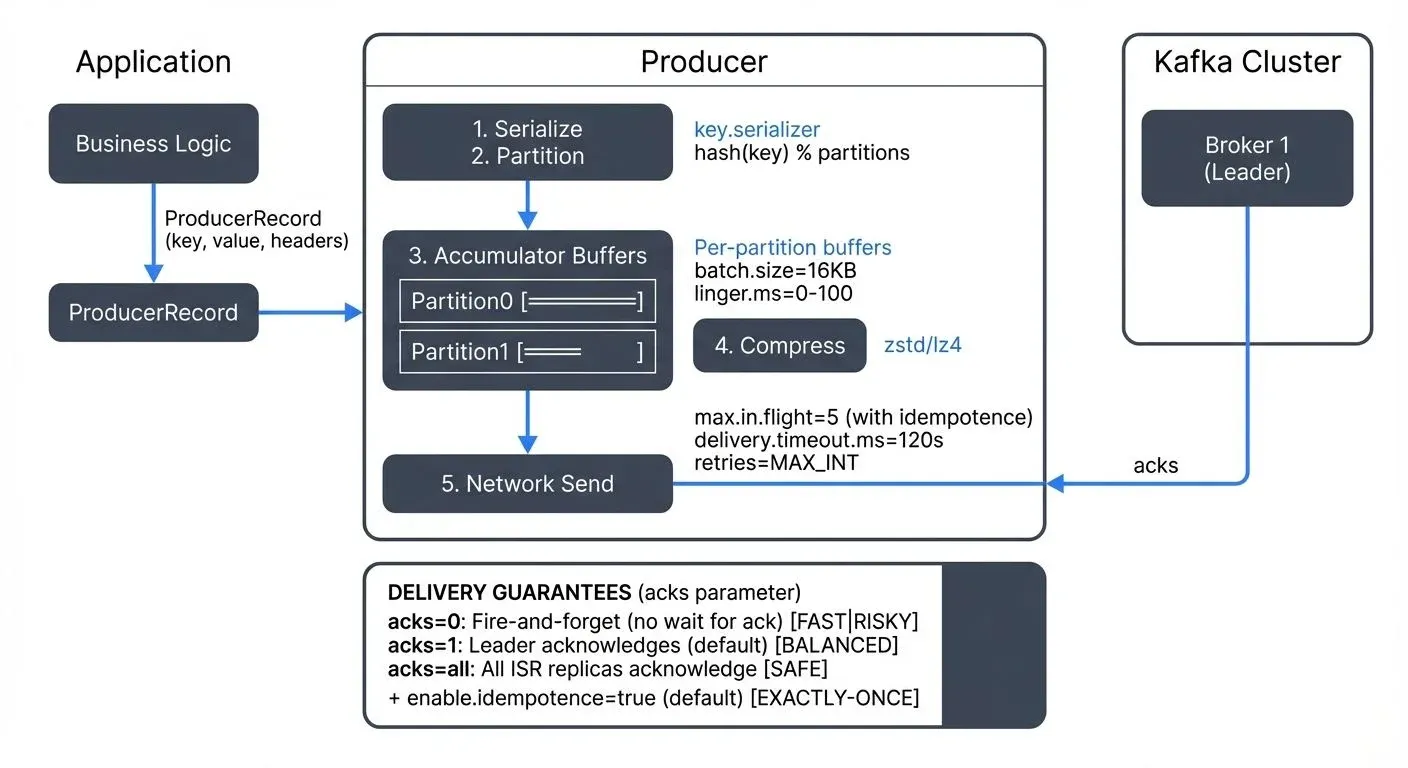
A Kafka producer sends records to a topic and routes each record to a partition. The client connects to brokers, fetches metadata, and batches writes for throughput. Producers control delivery policy, retries, compression, and partition choice, which sets latency, cost, and durability.
API Notes
A record carries a topic, optional key, value, and optional headers. The KafkaProducer is thread safe, so one shared instance per process often works best. You can send asynchronously with a callback or call Future.get() for sync behavior. Set a clear client.id, since brokers expose it in logs and metrics and this speeds triage.
Example: CLI quick start
kafka-console-producer --topic orders --bootstrap-server localhost:9092 \
  --property parse.key=true --property key.separator=:
Each key:value line becomes a keyed record.
Setup and Serialization
Producers must serialize keys and values into bytes. A schema keeps changes safe across teams and time.
Pick a format and a registry. Avro, Protobuf, and JSON Schema pair well with a Schema Registry that stores versions and enforces compatibility. For detailed serialization guidance, see Message Serialization in Kafka and Schema Registry and Schema Management.
Key properties:
bootstrap.serversfor initial brokers.key.serializerandvalue.serializerfor encoding.client.idfor traceability.compression.typeto reduce bytes on the wire.delivery.timeout.ms,request.timeout.ms, andretriesfor retry policy.
Example: Java producer with Avro and callback
Properties p = new Properties();
p.put("bootstrap.servers", "broker1:9092,broker2:9092");
p.put("key.serializer", "org.apache.kafka.common.serialization.StringSerializer");
p.put("value.serializer", "io.confluent.kafka.serializers.KafkaAvroSerializer");
p.put("schema.registry.url", "http://registry:8081");
p.put("client.id", "payments-prod-v1");
// Note: enable.idempotence=true is the default since Kafka 3.0+
p.put("acks", "all"); // Ensures durability with in-sync replicas

try (Producer<String, GenericRecord> producer = new KafkaProducer<>(p)) {
  ProducerRecord<String, GenericRecord> rec = new ProducerRecord<>("payments", "user-42", value);
  producer.send(rec, (md, ex) -> {
    if (ex != null) {
      // log error with client.id, topic, partition
    } else {
      // md.topic(), md.partition(), md.offset()
    }
  });
  producer.flush(); // optional if you close soon after
}
The try-with-resources block calls close(), which flushes in-flight records and releases resources.
Delivery Guarantees and Acknowledgments
Delivery behavior depends on acks, retries, idempotence, and transactions.
- At-most-once sends do not retry. You can lose data on faults.
- At-least-once sends retry. You can see duplicates.
- Exactly-once processing uses idempotent producers and transactions with read-committed consumers to avoid both loss and duplicates in a pipeline.
Key settings:
acks=0returns before storage. Lowest safety.acks=1waits for the leader write (default).acks=allwaits for the leader and in-sync replicas. Use with topicmin.insync.replicas. Required for exactly-once semantics.enable.idempotence=true(default since Kafka 3.0+) drops duplicates created by retries within a producer session. Enables Producer ID (PID) and sequence numbers per partition.- Transactions use a stable
transactional.id,initTransactions,beginTransaction, andcommitTransaction, with consumers set toisolation.level=read_committed. Provides atomic multi-partition writes and exactly-once delivery.
Transactional producer example
For exactly-once semantics across multiple partitions or topics:
Properties p = new Properties();
p.put("bootstrap.servers", "broker1:9092");
p.put("transactional.id", "payment-processor-001"); // Stable unique ID
p.put("enable.idempotence", "true"); // Required (default since 3.0+)
p.put("acks", "all"); // Required for transactions

try (KafkaProducer<String, String> producer = new KafkaProducer<>(p)) {
  producer.initTransactions(); // One-time initialization

  try {
    producer.beginTransaction();
    producer.send(new ProducerRecord<>("orders", "order-123", orderJson));
    producer.send(new ProducerRecord<>("inventory", "item-456", inventoryUpdate));
    producer.commitTransaction(); // Atomic commit across both topics
  } catch (Exception e) {
    producer.abortTransaction(); // Rollback on failure
    throw e;
  }
}
Consumers must set isolation.level=read_committed to see only committed messages. The transactional.id ties the producer to a transaction coordinator; if the producer crashes, a new instance with the same ID can fence out the old one and continue.
Error handling checklist
Treat these as retriable: NOT_LEADER_FOR_PARTITION, NETWORK_EXCEPTION, UNKNOWN_TOPIC_OR_PARTITION, REQUEST_TIMED_OUT. Treat these as non-retriable: INVALID_CONFIG, TOPIC_AUTHORIZATION_FAILED, RECORD_TOO_LARGE. Route non-retriable failures to a dead-letter topic or alert the team, then fix the cause. Handle NotEnoughReplicas on acks=all with min.insync.replicas by backing off or failing fast.
Safe write profile (Kafka 3.0+ defaults)
Since Kafka 3.0, the following safe settings are enabled by default:
acks=1  # Change to acks=all for stronger durability
enable.idempotence=true  # Default since 3.0+
retries=2147483647  # Max int, effectively unlimited
max.in.flight.requests.per.connection=5  # Safe with idempotence
delivery.timeout.ms=120000 # 2 minutes- For strongest durability, explicitly set
acks=alland ensure topic hasmin.insync.replicas=2or higher. - For strict per-key ordering during retries: With idempotence enabled (default), Kafka maintains partition order even with
max.in.flight.requests.per.connection=5. Only set this to1if you observe out-of-order issues with older brokers or need absolute guarantees, accepting lower throughput.
Keys, Partitions, and Ordering
Kafka guarantees order per partition per producer session. Your key choice decides partition placement and thus locality. For partition strategy details, see Kafka Topics, Partitions, Brokers: Core Architecture.
Practical rules:
- Use a stable business key, for example
user_idororder_id, to keep related events together. - Records without keys use a sticky strategy that forms larger batches while spreading load.
- Hot keys can overload a single partition. Use a composite key, a salted hash for the hottest keys, or a custom partitioner.
- Increasing partition count changes key-to-partition mapping. Plan the change during low traffic and confirm ordering needs.
Quick check for routing
Send a few key:message pairs with the console producer, then consume with partition info. You should see all records for a key in the same partition, in order.
Batching, Backpressure, and Throughput Tuning
The producer batches per partition to improve throughput. Larger batches raise efficiency and compression ratio at some latency cost. For handling downstream slowness and flow control, see Backpressure Handling in Streaming Systems.
Levers that matter:
batch.sizesets the target batch bytes (default 16384).linger.mslets the client wait briefly to coalesce records. Values around 1 to 5 ms help throughput while keeping tail latency reasonable.compression.typetrades CPU for bytes. Zstd (available since Kafka 2.1+) is recommended for new deployments in 2025, offering 20-30% better compression than gzip with comparable CPU usage. LZ4 works for speed with modest savings. Snappy is deprecated in favor of LZ4 or Zstd.buffer.memorybounds the client buffer (default 32MB). When full,send()blocks up tomax.block.msor throws.max.request.size(default 1MB) and brokermessage.max.bytescap record size. Use chunking or external object storage for very large payloads.
Watch record-send-rate, record-error-rate, request-latency-avg, p95 or p99 latency, compression-rate-avg, average batch size, and bufferpool-wait-ratio. Rising retries, timeouts, or buffer waits point to broker load or network issues. Tune, then measure again.
Modern producer monitoring (2025)
- Kafka 4.0+ improvements: Kafka 4.0 runs on KRaft (no ZooKeeper), which improves producer metadata fetch times and reduces tail latencies. Enhanced producer metrics expose per-partition batch stats and compression ratios. For KRaft migration details, see Understanding KRaft Mode in Kafka and ZooKeeper to KRaft Migration.
- Observability stack: Use Kafka Lag Exporter with Prometheus to track producer throughput and errors. Export JMX metrics (
kafka.producer:*) to Grafana dashboards. Monitor consumer lag to understand producer impact on downstream systems: Consumer Lag Monitoring. For commercial environments, Conduktor provides unified producer monitoring, real-time error tracking, schema validation, and governance across clusters. See Conduktor's topic management to view producer metrics, track message throughput, and inspect message content.
Where It Fits in Streaming Architectures
Producers sit at the edge of a streaming stack and shape downstream state and cost.
Common placements:
- Microservices publish domain events that drive other services. See Outbox Pattern for Reliable Event Publishing for safe event emission from databases.
- CDC to Kafka uses Debezium to read database logs and publish to topics. Stable schemas and keys reduce reprocess churn. See What is Change Data Capture (CDC) Fundamentals.
- Flink jobs read topics and write results to Kafka with exactly-once sinks that coordinate with Kafka transactions. See What is Apache Flink: Stateful Stream Processing.
- Kafka Streams reads and writes topics inside the same process. Idempotent or transactional producers prevent duplicate outputs on recovery.
- Kafka Connect acts as a managed producer for databases and SaaS sources.
- ETL to lakehouses publishes to topics that hydrate Iceberg or Delta tables through sinks. See Streaming to Lakehouse Tables.
Design notes:
- Pick keys that match downstream grouping, for example session joins on
session_id. - Use compatibility rules in the registry to protect consumers. See Schema Evolution Best Practices.
- If the pipeline needs end-to-end exactly-once, combine idempotent producers, transactions, and read-committed consumers. For deep dive, see Kafka Transactions Deep Dive.
- For headers usage (metadata, tracing, routing), see Using Kafka Headers Effectively.
Governance and Platform Support
The producer is the first gate for safety and reuse. Teams need clear controls on who can write, what shapes are allowed, and how changes get tracked.
What to enforce:
RBAC and ACLs for write access, for example a service account with write to orders-. See Access Control for Streaming and Kafka Security Best Practices.
- Schema policy for backward or full compatibility, required fields like
event_timeortenant_id, and validation in CI. - Field protection with masking or encryption on sensitive fields in transit or at a gateway. See PII Detection and Handling in Event Streams.
- Quotas per client ID to protect shared clusters. See Quotas and Rate Limiting in Kafka.
- Audit and lineage that record who wrote, when, with which schema version, and how downstream tables or features depend on that topic. See Audit Logging for Streaming Platforms.
- Standard producer libs or config bundles to keep defaults consistent across teams.
Platform support with Conduktor
Conduktor provides comprehensive producer governance and monitoring for Kafka clusters:
- RBAC and access control: Manage which service accounts can write to specific topics with fine-grained policies. Learn about service accounts and ACL management in Conduktor.
- Schema validation: Enforce schema compatibility rules before messages reach brokers, preventing breaking changes
- Data masking: Apply dynamic field-level masking on sensitive data (PII, credentials) at produce time using Conduktor interceptors
- Audit trail: Track all produce operations with full lineage - who wrote what, when, and with which schema version
- Monitoring: Real-time dashboards showing producer throughput, error rates, latency, and authorization failures across clusters via topic management
- Testing with Conduktor Gateway: Use Conduktor Gateway, a Kafka proxy, to inject chaos scenarios (latency, failures, broker outages) to test producer retry logic and resilience. For broader testing strategies, see Testing Strategies for Streaming Applications.
- Impact analysis: Visualize dependencies between producers, topics, schemas, and downstream consumers
This centralized approach keeps producer changes safe, traceable, and compliant at scale without requiring custom tooling.
Related Concepts
- Schema Registry and Schema Management - Ensures producers write messages with validated, compatible schemas that consumers can reliably deserialize.
- Exactly-Once Semantics in Kafka - Combines idempotent and transactional producers to achieve end-to-end exactly-once delivery guarantees.
- Kafka Security Best Practices - Critical for securing producer authentication, authorization, and data encryption in production environments.
Summary
Producers turn domain events and CDC streams into durable topic data. Their settings for serialization, acks, retries, batching, and keys decide reliability, latency, and cost for the whole stack.
Modern defaults (Kafka 3.0+) include idempotent producers, making at-least-once delivery safe by default. Kafka 4.0 with KRaft improves metadata fetch performance and reduces tail latencies. For 2025 deployments, use Zstd compression, monitor with Kafka Lag Exporter and Prometheus, and enforce governance with platforms like Conduktor.
Streaming engines such as Flink and Kafka Streams depend on producer choices for correct joins, windows, and state. Teams reach stable results with schema-aware encoding, safe acks with idempotence (or transactions for exactly-once), tuned batching, and clear key strategy. Governance platforms add RBAC, schema policy, masking, audit, lineage, quotas, and shared defaults, which keeps producer changes safe and traceable at scale.
Sources and References
- Apache Kafka documentation, Producer API and configuration: https://kafka.apache.org/documentation/
- Confluent documentation, Producer configs, idempotence, transactions, and exactly-once semantics: https://docs.confluent.io/platform/current/clients/producer.html
- Apache Flink documentation, Kafka connector and sinks: https://nightlies.apache.org/flink/flink-docs-stable/docs/connectors/datastream/kafka/
- Debezium documentation, Architecture and Kafka topics: https://debezium.io/documentation/
- Kafka Improvement Proposals index, producer design background: https://cwiki.apache.org/confluence/display/KAFKA/Kafka+Improvement+Proposals
](http://localhost:4321/articles/kafka-producers-sending-messages-to-topics)