
Kafka Transactions Deep Dive
In distributed systems, processing messages exactly once is hard. Traditional message delivery offers two guarantees: at-most-once (messages may be lost) and at-least-once (messages may be duplicated). For critical applications like financial transactions, inventory management, or payment processing, neither is acceptable.
Kafka transactions solve this by enabling exactly-once semantics (EOS) across producers, brokers, and consumers.
This article is a technical deep dive into Kafka's transaction implementation. For a broader overview of exactly-once semantics including use cases and simpler explanations, see Exactly-Once Semantics in Kafka. For foundational Kafka concepts, refer to Apache Kafka. 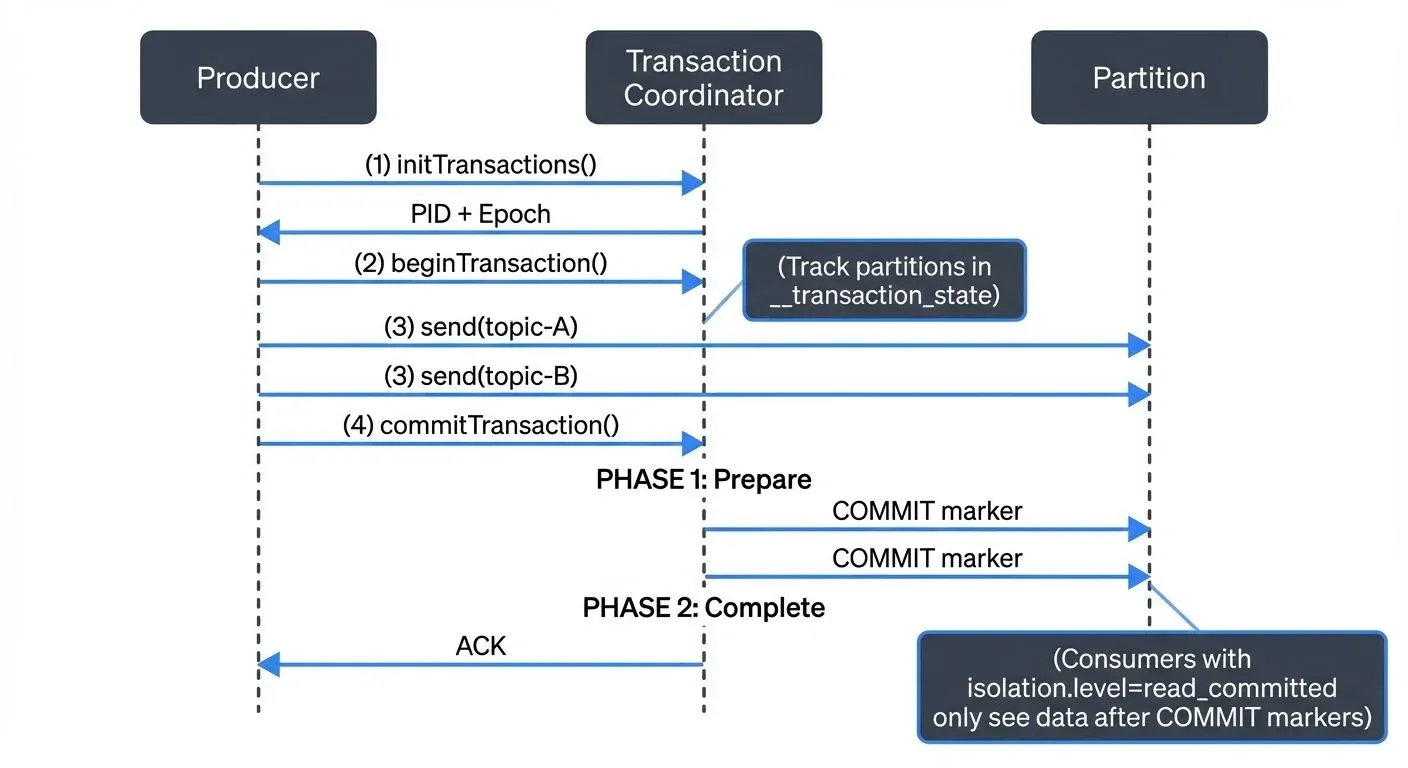
Understanding Kafka Transactions
Kafka transactions allow producers to send multiple messages to multiple partitions atomically. Either all messages in a transaction are committed and become visible to consumers, or none are. This atomic guarantee extends across multiple topic partitions and even spans multiple Kafka clusters in some configurations.
The Core Problem
Consider a stream processing application that reads from topic A, transforms the data, and writes results to topic B. Without transactions, failures can lead to:
- Duplicate writes: A producer crashes after writing to topic B but before committing its consumer offset for topic A
- Data loss: Consumer commits offset before processing completes
- Inconsistent state: Partial writes when processing multiple output records
Transactions solve these issues by coordinating producer writes and consumer offset commits in a single atomic operation.
How Kafka Transactions Work
Kafka's transactional mechanism relies on several key components working together to maintain consistency across distributed operations.
Transaction Coordinator
The transaction coordinator is a broker-side component responsible for managing transaction state. Each producer with transactions enabled is assigned a transaction coordinator based on its transactional.id. The coordinator:
- Assigns Producer IDs (PIDs) and epoch numbers for idempotency
- Maintains transaction logs in the internal
__transaction_statetopic (which stores transaction metadata, state transitions, and participant partitions) - Coordinates the two-phase commit protocol across partitions (a distributed algorithm ensuring all participants agree to commit or abort)
- Handles transaction timeouts and recovery
In Kafka 4.0+ with KRaft mode (Kafka's ZooKeeper-free architecture), transaction coordinator performance has been significantly improved. KRaft-based transaction coordinators provide faster transaction commits, reduced coordinator overhead, and better scalability compared to the legacy ZooKeeper-based implementation. For more on KRaft's benefits, see Understanding KRaft Mode in Kafka.
Transactional Producer Flow
When a producer initiates a transaction, the following sequence occurs:
- Initialization: Producer registers with the transaction coordinator using its
transactional.id - Begin Transaction: Producer starts a transaction locally
- Add Partitions: As the producer writes to partitions, the coordinator tracks which partitions are involved
- Commit/Abort: Producer sends commit or abort request to coordinator
- Two-Phase Commit: Coordinator writes commit markers to all involved partitions and updates the transaction log
Control Messages and Consumer Isolation
Kafka uses special control messages (COMMIT and ABORT markers) written to partitions to signal transaction boundaries. Consumers configured with isolation.level=read_committed only see messages from committed transactions, while those set to read_uncommitted see all messages.
Transactional APIs and Configuration
Implementing transactions requires specific configuration on both producers and consumers.
Producer Configuration
Properties props = new Properties();
props.put("bootstrap.servers", "localhost:9092");
props.put("transactional.id", "my-transactional-producer");
// Note: enable.idempotence is default true in Kafka 3.0+, explicit setting optional
props.put("enable.idempotence", "true");
props.put("acks", "all");

KafkaProducer<String, String> producer = new KafkaProducer<>(props);
producer.initTransactions();

try {
    producer.beginTransaction();
    producer.send(new ProducerRecord<>("topic-a", "key", "value1"));
    producer.send(new ProducerRecord<>("topic-b", "key", "value2"));
    producer.commitTransaction();
} catch (Exception e) {
    producer.abortTransaction();
}
The transactional.id must be unique per producer instance and enables the coordinator to identify and fence zombie producers (producers that appear to have failed but resume later). Note that idempotent producers (enable.idempotence=true) are the default since Kafka 3.0+, providing automatic duplicate prevention even without explicit transactions. For comprehensive coverage of producer configuration and idempotence, see Kafka Producers.
Consumer Configuration
Properties props = new Properties();
props.put("bootstrap.servers", "localhost:9092");
props.put("group.id", "my-consumer-group");
props.put("isolation.level", "read_committed");
props.put("enable.auto.commit", "false");

KafkaConsumer<String, String> consumer = new KafkaConsumer<>(props);
Disabling auto-commit is crucial when using transactions, as you'll manually commit offsets within the transaction boundary. For more details on consumer group coordination and offset management, see Kafka Consumer Groups Explained.
Consume-Process-Produce Pattern
The most common transactional pattern combines consumption and production:
while (true) {
    ConsumerRecords<String, String> records = consumer.poll(Duration.ofMillis(100));

    producer.beginTransaction();
    try {
        for (ConsumerRecord<String, String> record : records) {
            // Process and produce
            ProducerRecord<String, String> output = transform(record);
            producer.send(output);
        }

        // Commit consumer offsets as part of transaction
        producer.sendOffsetsToTransaction(
            getOffsets(records),
            consumer.groupMetadata()
        );

        producer.commitTransaction();
    } catch (Exception e) {
        producer.abortTransaction();
    }
}
Real-World Use Cases
Financial Payment Processing
A payment processing system reads payment requests from a Kafka topic, validates them, debits accounts, and writes confirmation records. Transactions ensure that if any step fails, the entire operation rolls back, preventing partial payments or duplicate charges. For patterns implementing reliable payment processing and financial data flows, see Streaming Data in Financial Services.
Multi-System Data Synchronization
When synchronizing data between a database and Kafka, transactions guarantee that database changes and Kafka messages are committed together. For example, an e-commerce platform updating inventory in PostgreSQL while publishing availability events to Kafka can use transactions to maintain consistency. For coordinating transactions across multiple microservices using event-driven patterns, see Saga Pattern for Distributed Transactions. For reliable event publishing from databases, the Outbox Pattern for Reliable Event Publishing provides complementary guarantees.
Stream Processing Pipelines
Kafka Streams and Flink use transactions internally to provide exactly-once processing guarantees. When aggregating real-time analytics or joining multiple streams, transactions ensure that state stores and output topics remain consistent even during failures. Kafka Streams leverages the exactly_once_v2 protocol (introduced in Kafka 2.5) for improved performance, and Kafka 4.0+ further optimizes transaction handling in KRaft mode. For a detailed comparison of these frameworks and their transactional capabilities, see Kafka Streams vs Apache Flink.
Monitoring and Troubleshooting Transactions
Understanding transaction health requires monitoring several key metrics and understanding common failure patterns.
Key Metrics
Monitor these critical transaction metrics to ensure healthy operation:
transaction-state: Number of transactions in each state (ongoing, prepare commit, completed) - helps identify stuck transactionstxn-commit-time-ms: Time taken to commit transactions - increases may indicate coordinator or network issuesproducer-id-expiration-time-ms: Time before inactive producer IDs are expired - tracks producer lifecyclelast-stable-offset-lag: Gap between log end offset and last stable offset (LSO) - measures the backlog of uncommitted transactions waiting to be read byread_committedconsumers- Open-source monitoring: For Prometheus-based monitoring, Kafka Lag Exporter (the 2025 standard for consumer lag tracking) provides transaction-aware metrics. JMX metrics can be scraped using Prometheus JMX Exporter to track transaction coordinator performance. Tools like Burrow can detect consumer lag issues related to transaction processing delays.
- Commercial platforms: Tools like Conduktor provide comprehensive visibility into transactional flows through topic monitoring, allowing teams to visualize transaction states, identify hanging transactions, and debug configuration issues. The platform can surface warnings when transaction timeouts are misconfigured or when zombie producers are detected, and provides real-time alerts on transaction performance degradation. Conduktor Gateway, a Kafka proxy, also enables chaos testing of transactional scenarios by injecting faults, latency, and network partitions to validate transaction behavior under failure conditions. For comprehensive testing strategies including transaction testing, see Testing Strategies for Streaming Applications and Chaos Engineering for Streaming Systems.
Common Issues
- Transaction Timeout: If
transaction.timeout.msis too short for your processing time, transactions will abort automatically. Monitor processing times and adjust accordingly. - Zombie Fencing: When a producer is fenced (its epoch is incremented), it can no longer commit transactions. This is by design to prevent split-brain scenarios, but requires proper producer lifecycle management.
- Coordinator Overload: High transaction volumes can overload the transaction coordinator. Consider partitioning transactional load across multiple
transactional.idvalues.
Conduktor Console: Inspect stream processing topology and debug stateful operators. Explore Conduktor Console →
Best Practices and Considerations
When to Use Transactions
Transactions add latency and complexity. Use them when:
- Exactly-once semantics are required for correctness
- Processing spans multiple partitions or topics
- You're implementing consume-process-produce patterns
Avoid transactions for:
- Simple logging or metrics where occasional duplicates are acceptable
- Ultra-low latency scenarios where the overhead is prohibitive
- Single-partition writes where idempotence alone suffices
Performance Implications
Transactions introduce several performance considerations:
- Increased latency: Two-phase commit adds network round trips
- Throughput impact: Transaction state management consumes broker resources
- Storage overhead: Control messages and transaction logs require additional storage
Batch messages within transactions to amortize the coordination overhead. A transaction writing 100 messages is much more efficient than 100 transactions writing one message each.
Idempotence vs. Transactions
Kafka's idempotent producer (enable.idempotence=true, default since Kafka 3.0+) prevents duplicate writes within a single partition but doesn't coordinate across partitions or provide atomic multi-partition writes. Transactions build on idempotence to provide cross-partition atomicity and exactly-once semantics (EOS). Use idempotence alone when you only need duplicate prevention without multi-partition coordination. For a broader overview of exactly-once semantics including idempotence, transactions, and their relationship, see Exactly-Once Semantics in Kafka.
Transaction Timeout Configuration
Set transaction.timeout.ms based on your maximum expected processing time, including retries. The default is 60 seconds, but long-running transformations may need higher values. However, longer timeouts delay the detection of failed transactions, so balance carefully.
Summary
Kafka transactions coordinate atomic writes across multiple partitions and topics. The transaction coordinator, two-phase commit protocol, and control messages ensure that either all messages in a transaction are visible to consumers or none are.
The transactional APIs enable patterns like consume-process-produce, where reading, transforming, and writing happen atomically. This is essential for financial systems, data synchronization, and stream processing pipelines where consistency is critical.
Transactions add latency and complexity, but are necessary for applications that cannot tolerate duplicates or data loss.
Key 2025 updates:
- Idempotent producers are now default in Kafka 3.0+, providing automatic duplicate prevention
- Kafka 4.0+ with KRaft mode delivers significantly improved transaction coordinator performance with faster commits and reduced overhead
- Modern monitoring tools like Kafka Lag Exporter and Conduktor provide enhanced visibility into transaction health and performance
- The
exactly_once_v2protocol in Kafka Streams (2.5+) combined with KRaft optimizations makes exactly-once semantics more performant than ever
Related Concepts
- Exactly-Once Semantics in Kafka - Overview of exactly-once guarantees in Kafka
- Kafka Topics, Partitions, and Brokers: Core Architecture - Foundational architecture enabling transactions
- Saga Pattern for Distributed Transactions - Using transactions in distributed workflows
Sources and References
- Apache Kafka Documentation - Transactions - Official documentation covering transaction semantics and configuration
- KIP-98: Exactly Once Delivery and Transactional Messaging - Original Kafka Improvement Proposal detailing transaction design
- Confluent: Transactions in Apache Kafka - Technical deep-dive from Kafka creators
- Exactly-once Semantics in Kafka Streams - How Kafka Streams leverages transactions
- Understanding Kafka Transaction Coordinator - Practical guide to transaction internals and troubleshooting