
What is Apache Flink? Stateful Stream Processing
Apache Flink (currently version 1.18 as of 2024, with 1.19 in development) is an open-source distributed stream processing framework designed to handle unbounded and bounded data streams with low latency and high throughput. Unlike traditional batch processing systems, Flink treats streams as the primary data model, making it ideal for real-time analytics, event-driven applications, and continuous data pipelines.
At its core, Flink excels at stateful stream processing — maintaining and updating computation state across millions of events while guaranteeing exactly-once processing semantics. This makes Flink a practical tool for data engineers building mission-critical real-time applications.
What is Stream Processing?
Stream processing is a computational paradigm that processes data continuously as it arrives, rather than waiting to collect batches of data. This approach enables real-time insights and immediate responses to events.
Key characteristics of stream processing:
- Unbounded data: Streams have no defined end, data arrives continuously
- Low latency: Events are processed within milliseconds to seconds
- Event time semantics: Processing based on when events actually occurred, not when they arrived
- Stateful operations: Maintaining context across events (counters, windows, joins)
Traditional batch systems like MapReduce process finite datasets in scheduled intervals. Stream processors like Flink handle infinite streams in real-time, making them essential for use cases like fraud detection, real-time recommendations, and operational monitoring.
Why Apache Flink?
Flink distinguishes itself from other stream processing frameworks through several key capabilities:
True Stream Processing
Flink treats streams as first-class citizens. While some frameworks operate on micro-batches (processing small batches frequently), Flink processes events individually as they arrive. This architecture delivers consistently low latency without the inherent delays of batching.
Stateful Computations
Flink provides sophisticated state management that allows applications to remember information across events. This state can be:
- Keyed state: Associated with specific keys (e.g., counting login attempts per user ID, tracking shopping cart totals per session)
- Operator state: Maintained by operator instances (e.g., maintaining Kafka partition offsets, buffering records)
- Broadcast state: Replicated across all parallel instances (e.g., sharing fraud detection rules or configuration across all processing nodes)
State is fault-tolerant, backed by configurable state backends (HashMapStateBackend for in-memory state, EmbeddedRocksDBStateBackend for disk-based state on large-scale applications, or custom implementations), and automatically restored during recovery. Since Flink 1.13+, the state backend API has been modernized for better performance and maintainability.
Exactly-Once Semantics
Flink guarantees exactly-once processing semantics through its distributed snapshotting mechanism. This ensures that each event affects the final result exactly once, even in the presence of failures, critical for financial transactions, billing systems, and other scenarios where accuracy is non-negotiable. Flink achieves this by periodically creating consistent snapshots of all operator state and input stream positions, which can be restored upon failure.
Event Time Processing
Flink natively supports event time semantics with watermarks, allowing accurate windowing and aggregations even when events arrive out of order or delayed.
Watermarks are special timestamps that flow through the stream indicating "all events with timestamps before this watermark have been received." This allows Flink to trigger computations on complete data even when events arrive late or out of order. For example, if you're computing 5-minute windows of user activity, watermarks tell Flink when it's safe to close a window and emit results, even if some events from that time period arrived late due to network delays.
This capability is essential for real-world streaming where network delays and distributed systems introduce timing complexities. For detailed coverage of watermark strategies and handling late-arriving data, see Event Time and Watermarks in Flink.
How Apache Flink Works
Architecture Overview
Flink operates on a master-worker architecture: 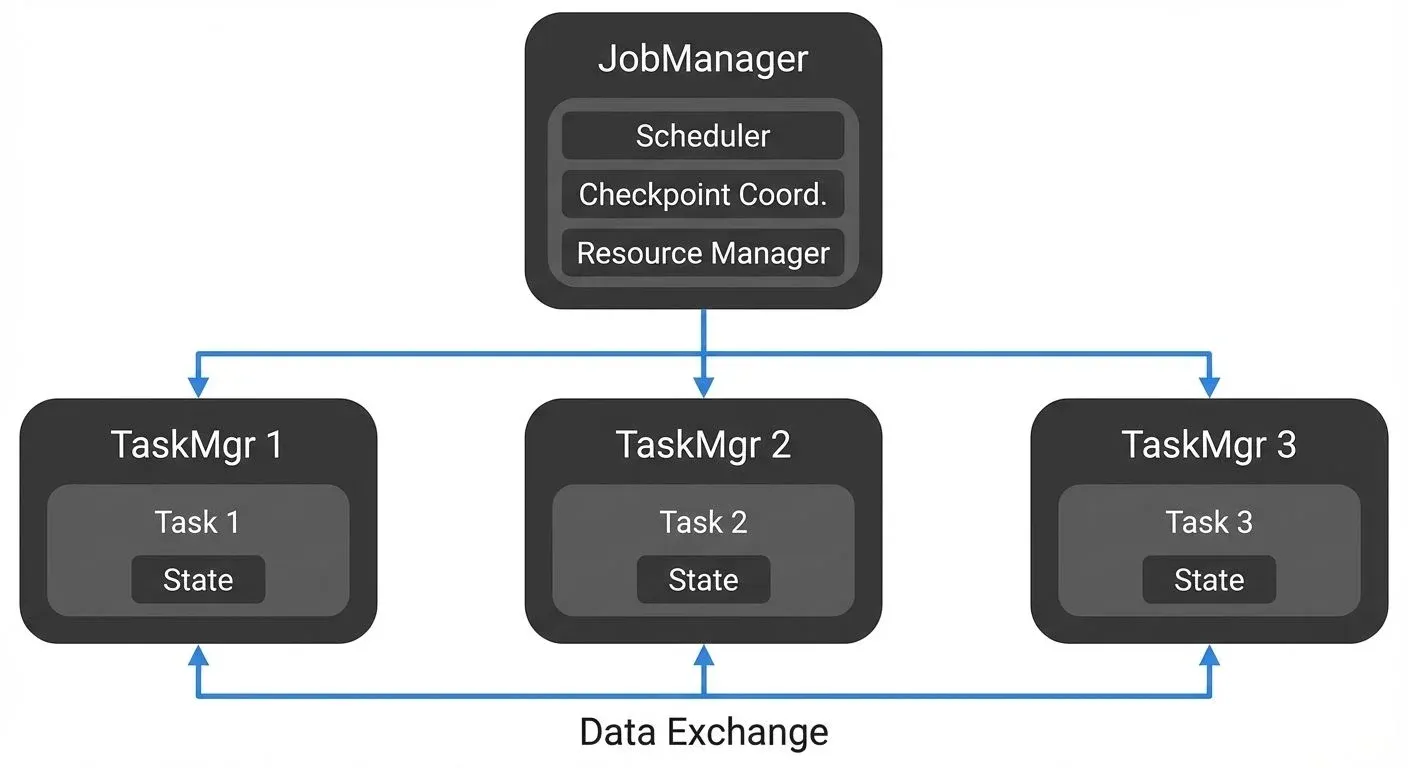
- JobManager: Coordinates distributed execution, manages checkpoints, and handles job scheduling.
- TaskManagers: Execute tasks, maintain local state, and communicate with each other for data exchange.
Basic Flink Application
A Flink stream processing pipeline flows like this: 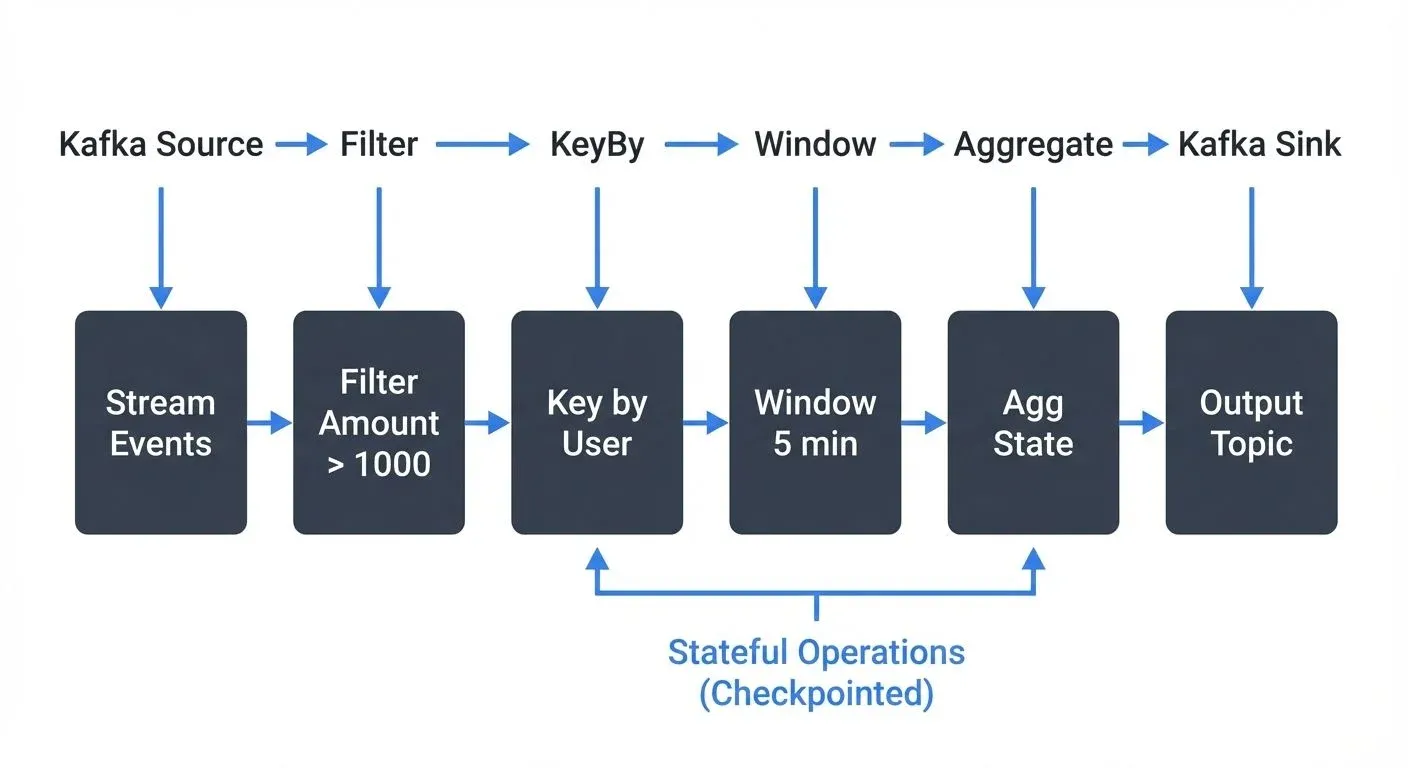
Key concepts demonstrated:
- Source integration with Kafka
- Watermark strategy for handling late events
- Keyed streams (KeyBy operation): Partitions the data stream by a key (e.g., user ID) so that all events for the same key are processed together on the same parallel task, enabling stateful operations
- Windowing for time-based aggregations
- Fault tolerance via checkpointing
Code Example: Stateful Stream Processing
Here's a practical example demonstrating stateful stream processing with Flink and Kafka:
import org.apache.flink.api.common.eventtime.WatermarkStrategy;
import org.apache.flink.api.common.serialization.SimpleStringSchema;
import org.apache.flink.connector.kafka.source.KafkaSource;
import org.apache.flink.connector.kafka.sink.KafkaSink;
import org.apache.flink.streaming.api.datastream.DataStream;
import org.apache.flink.streaming.api.environment.StreamExecutionEnvironment;
import org.apache.flink.streaming.api.windowing.assigners.TumblingEventTimeWindows;
import org.apache.flink.streaming.api.windowing.time.Time;

import java.time.Duration;

public class StatefulProcessingExample {
    public static void main(String[] args) throws Exception {
        // Create execution environment
        StreamExecutionEnvironment env = StreamExecutionEnvironment.getExecutionEnvironment();

        // Enable checkpointing for fault tolerance (every 60 seconds)
        env.enableCheckpointing(60000);

        // Configure state backend for production use
        env.setStateBackend(new HashMapStateBackend());
        env.getCheckpointConfig().setCheckpointStorage("s3://your-bucket/flink-checkpoints");

        // Create Kafka source with exactly-once semantics
        KafkaSource<String> source = KafkaSource.<String>builder()
            .setBootstrapServers("localhost:9092")
            .setTopics("user-events")
            .setGroupId("flink-processor-group")
            .setValueOnlyDeserializer(new SimpleStringSchema())
            .build();

        // Read from Kafka with watermark strategy (5 seconds out-of-orderness)
        DataStream<String> stream = env.fromSource(
            source,
            WatermarkStrategy
                .<String>forBoundedOutOfOrderness(Duration.ofSeconds(5))
                .withTimestampAssigner((event, timestamp) -> extractTimestamp(event)),
            "Kafka Source"
        );

        // Stateful processing: aggregate events per user over 5-minute windows
        DataStream<String> results = stream
            .map(event -> parseEvent(event))  // Parse JSON to Event object
            .keyBy(event -> event.getUserId())  // Partition by user ID
            .window(TumblingEventTimeWindows.of(Time.minutes(5)))
            .aggregate(new EventAggregator())  // Custom aggregation logic
            .map(result -> result.toJson());

        // Write results back to Kafka
        KafkaSink<String> sink = KafkaSink.<String>builder()
            .setBootstrapServers("localhost:9092")
            .setRecordSerializer(...)
            .build();

        results.sinkTo(sink);

        // Execute the Flink job
        env.execute("Stateful User Event Processing");
    }
}
This example demonstrates:
- Checkpointing configuration for fault tolerance
- State backend setup (HashMapStateBackend with S3 checkpoint storage)
- Kafka source/sink integration with exactly-once guarantees
- Watermark strategy to handle 5 seconds of out-of-order events
- Keyed state via
keyBy()for per-user aggregation - Windowing with 5-minute tumbling windows
For more detailed examples and advanced patterns, see Flink DataStream API: Building Streaming Applications and Flink State Management and Checkpointing.
Flink and the Data Streaming Ecosystem
Kafka Integration
Apache Flink and Apache Kafka form a powerful combination in modern data architectures. Kafka serves as the distributed messaging backbone, while Flink provides the stream processing engine. For foundational Kafka concepts, see Apache Kafka.
Flink Kafka Connector features (Flink 1.14+):
- Exactly-once source/sink semantics with Kafka transactions (see Exactly-Once Semantics in Kafka)
- Dynamic partition discovery, automatically detects new Kafka partitions and adjusts processing
- Consumer position tracking for fault tolerance
- Support for multiple serialization formats: Avro, JSON, Protobuf (see Avro vs Protobuf vs JSON Schema)
A typical architecture pattern: 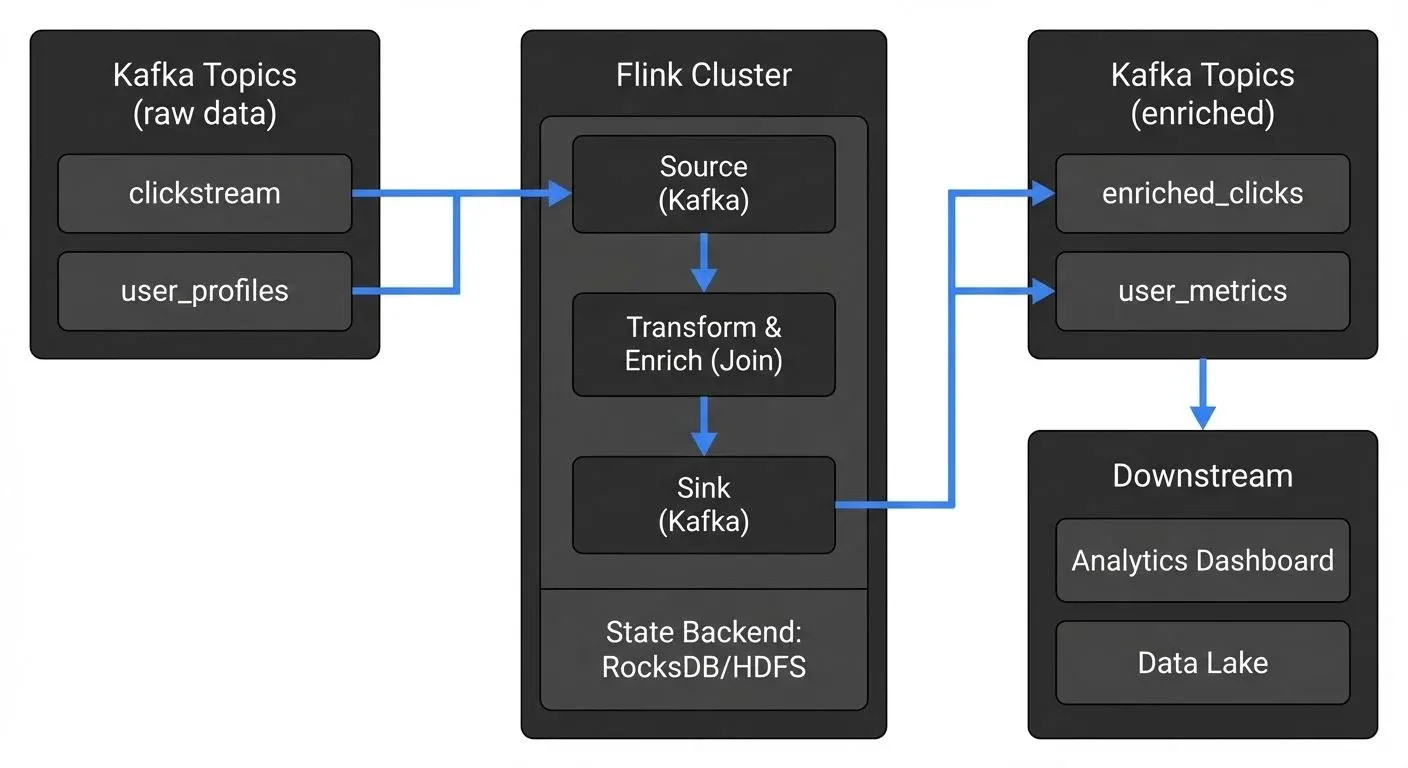
Observability and Governance
As Flink applications scale across multiple Kafka topics and processing stages, maintaining visibility becomes crucial. Modern observability and governance platforms provide essential capabilities:
Flink Application Monitoring:
- Flink Web UI: Built-in dashboard for job metrics, checkpoints, and task management
- Metrics reporters: Export metrics to Prometheus, Grafana, or other monitoring systems
- Consumer lag monitoring: Track processing lag for Kafka sources (see Consumer Lag Monitoring)
- Backpressure detection: Identify bottlenecks in processing pipelines (see Backpressure Handling in Streaming Systems)
Kafka Ecosystem Governance:
- Data lineage tracking: Understanding how data flows through Flink jobs and Kafka topics (see Data Lineage Tracking)
- Schema management: Ensuring compatibility across producers and consumers
- Topic monitoring: Observing throughput, lag, and consumer group health using tools like Conduktor for comprehensive Kafka governance, monitoring, and data quality validation. Manage Kafka topics and monitor cluster health in production environments
- Data quality gates: Validating stream data quality before and after Flink processing (see Building a Data Quality Framework)
This governance layer is essential for production environments where data teams need to understand dependencies, debug issues, and ensure compliance. For audit requirements, see Audit Logging for Streaming Platforms.
Other Integrations
Flink integrates with numerous systems in the data ecosystem:
- Cloud Storage: S3, GCS, Azure Blob Storage for state backends and checkpoints (modern deployments); HDFS for on-premises
- Databases: Elasticsearch, Cassandra, PostgreSQL, MySQL via JDBC for sinks
- Messaging: Amazon Kinesis, Apache Pulsar, RabbitMQ as sources/sinks
- Data Formats: Avro, Parquet, ORC, JSON for serialization (see Avro vs Protobuf vs JSON Schema)
- Table Formats: Apache Iceberg integration for lakehouse architectures (see Apache Iceberg)
Flink SQL and Table API
Beyond the DataStream API, Flink provides SQL and Table API (Flink 1.9+) for declarative stream processing. This approach makes Flink accessible to SQL developers and enables rapid development of streaming pipelines without writing Java or Scala code.
Example: Real-time aggregation with Flink SQL
-- Define Kafka source table
CREATE TABLE transactions (
  user_id STRING,
  product_id STRING,
  amount DECIMAL(10, 2),
  transaction_time TIMESTAMP(3),
  WATERMARK FOR transaction_time AS transaction_time - INTERVAL '5' SECOND
) WITH (
  'connector' = 'kafka',
  'topic' = 'transactions',
  'properties.bootstrap.servers' = 'localhost:9092',
  'format' = 'json'
);

-- Real-time aggregation: total sales per user every 5 minutes
CREATE TABLE user_sales AS
SELECT
  user_id,
  TUMBLE_END(transaction_time, INTERVAL '5' MINUTES) AS window_end,
  COUNT(*) AS transaction_count,
  SUM(amount) AS total_amount
FROM transactions
GROUP BY user_id, TUMBLE(transaction_time, INTERVAL '5' MINUTES);
Flink SQL supports:
- Streaming joins: Join multiple Kafka topics in real-time
- Complex event processing: Pattern matching with
MATCH_RECOGNIZE - Temporal tables: Join streaming data with slowly-changing dimensions
- User-defined functions: Extend SQL with custom logic
For comprehensive coverage, see Flink SQL and Table API for Stream Processing.
Deployment Options
Flink supports multiple deployment modes for different use cases:
Application Mode (Recommended for Production)
Introduced in Flink 1.11+, Application Mode provides dedicated cluster resources per application:
- Isolated resources: Each application gets its own JobManager
- Efficient resource usage: Cluster spins up/down with the application
- Better security: No sharing of resources between applications
Kubernetes Deployment
The Flink Kubernetes Operator (1.0+ released in 2022) provides native Kubernetes integration:
- Deploy Flink applications as Kubernetes custom resources
- Automatic scaling and recovery
- Integration with Kubernetes ecosystem (service mesh, monitoring, etc.)
apiVersion: flink.apache.org/v1beta1
kind: FlinkDeployment
metadata:
  name: stateful-processing-job
spec:
  image: flink:1.18
  flinkVersion: v1_18
  jobManager:
    resource:
      memory: "2048m"
      cpu: 1
  taskManager:
    resource:
      memory: "4096m"
      cpu: 2
For production deployments, see Infrastructure as Code for Kafka Deployments for deployment automation patterns.
Modern Features (Flink 1.13+)
Recent Flink versions include significant improvements:
- Unaligned checkpoints (1.11+): Better handling of backpressure scenarios
- Changelog state backend (1.15+): Faster recovery times by maintaining state change logs
- Improved Kafka connector (1.14+): Better exactly-once performance and dynamic partition handling
- Batch execution mode (1.12+): Process bounded datasets with streaming APIs for unified programming
Common Use Cases
Real-Time Analytics
Calculating metrics, dashboards, and KPIs as events occur. Example: processing 1 million events per second to track website user behavior patterns with sub-100ms latency to power personalization engines.
Event-Driven Applications
Building applications that react to patterns and conditions in data streams. Example: fraud detection systems that analyze transaction patterns and trigger alerts within milliseconds. For architectural patterns, see Event-Driven Architecture and Event-Driven Microservices Architecture.
Data Pipelines and ETL
Continuous ingestion, transformation, and delivery of data streams. Example: enriching clickstream data with user profiles and writing to a data warehouse for analytics (see Clickstream Analytics with Kafka). Flink is commonly used for:
- Change Data Capture (CDC): Capturing database changes in real-time (see Implementing CDC with Debezium)
- Data warehouse loading: Continuous ETL pipelines (see CDC for Real-Time Data Warehousing)
- Lakehouse ingestion: Writing to Apache Iceberg tables with exactly-once guarantees
Stream Joins and Enrichment
Combining multiple streams or joining streams with reference data. Example: joining payment events with user account data to create enriched transaction records. Flink supports multiple join types:
- Window joins: Join events within time windows
- Interval joins: Join events within time intervals (e.g., "join events that occur within 10 minutes")
- Temporal table joins: Join streaming data with versioned reference data
When to Choose Flink
Flink is ideal when you need:
- True low-latency processing: Millisecond to second latency requirements
- Complex stateful operations: Windowing, aggregations, joins across large state
- Exactly-once guarantees: Financial transactions, billing, compliance-critical workloads
- Event time semantics: Out-of-order event handling with watermarks
- High throughput: Processing millions of events per second
- Advanced operations: Complex event processing, pattern matching, temporal joins
Consider alternatives when:
- Simple transformations: Kafka Streams may be simpler for basic Kafka-to-Kafka processing (see Introduction to Kafka Streams)
- Batch-oriented workloads: Spark may be better for primarily batch processing with occasional streaming (see Flink vs Spark Streaming: When to Choose Each)
- SQL-only requirements: If your team only knows SQL and doesn't need advanced DataStream features, consider lighter SQL engines
Common Pitfalls and Best Practices
State Management:
- Pitfall: Not cleaning up old state, leading to unbounded state growth and memory issues
- Solution: Implement state TTL (Time-To-Live) and use timers to clean up expired state
Checkpointing:
- Pitfall: Checkpoint intervals too short causing overhead, or too long risking data loss
- Solution: Start with 60-second intervals, tune based on recovery time objectives and state size
Parallelism:
- Pitfall: Mismatched parallelism between operators causing bottlenecks
- Solution: Match parallelism to Kafka partition counts for source operators; tune downstream based on CPU profiling
Watermarks:
- Pitfall: Watermark delay too aggressive, dropping valid late events
- Solution: Monitor late event metrics and adjust watermark bounds based on actual data patterns
Memory Configuration:
- Pitfall: Insufficient memory for RocksDB state backend causing disk thrashing
- Solution: Allocate sufficient managed memory; consider HashMapStateBackend for smaller state
For production deployment best practices, see Kafka Performance Tuning Guide and CI/CD Best Practices for Streaming Applications.
Summary
Apache Flink is a mature, production-ready framework for stateful stream processing with strong consistency guarantees. Its support for event time processing, exactly-once semantics, and state management makes it a solid choice for demanding real-time applications.
For data engineers, Flink provides the tools to build complex streaming pipelines that integrate with ecosystems like Kafka while maintaining the reliability and performance required for production systems. Combined with governance tools for visibility and control, Flink covers a wide range of real-time data processing needs.
Related Concepts
- Exactly-Once Semantics - Flink's implementation of exactly-once processing and how it compares across frameworks
- Backpressure Handling in Streaming Systems - Managing flow control and backpressure in Flink pipelines
- Real-Time Analytics with Streaming Data - Patterns for building analytics applications on top of Flink
Sources and References
- Apache Flink Official Documentation - Comprehensive documentation covering concepts, APIs, and operations
- Flink: Stream Processing for the Real World - Academic paper detailing Flink's architecture and design principles
- The Dataflow Model - Google's paper on stream processing concepts that influenced Flink
- Apache Flink GitHub Repository - Source code and community contributions
- Kafka + Flink: A Practical Guide - Integration patterns and best practices